Happy Feet Turns 20: The Dancing Penguin That Beat Bond and Won an Oscar
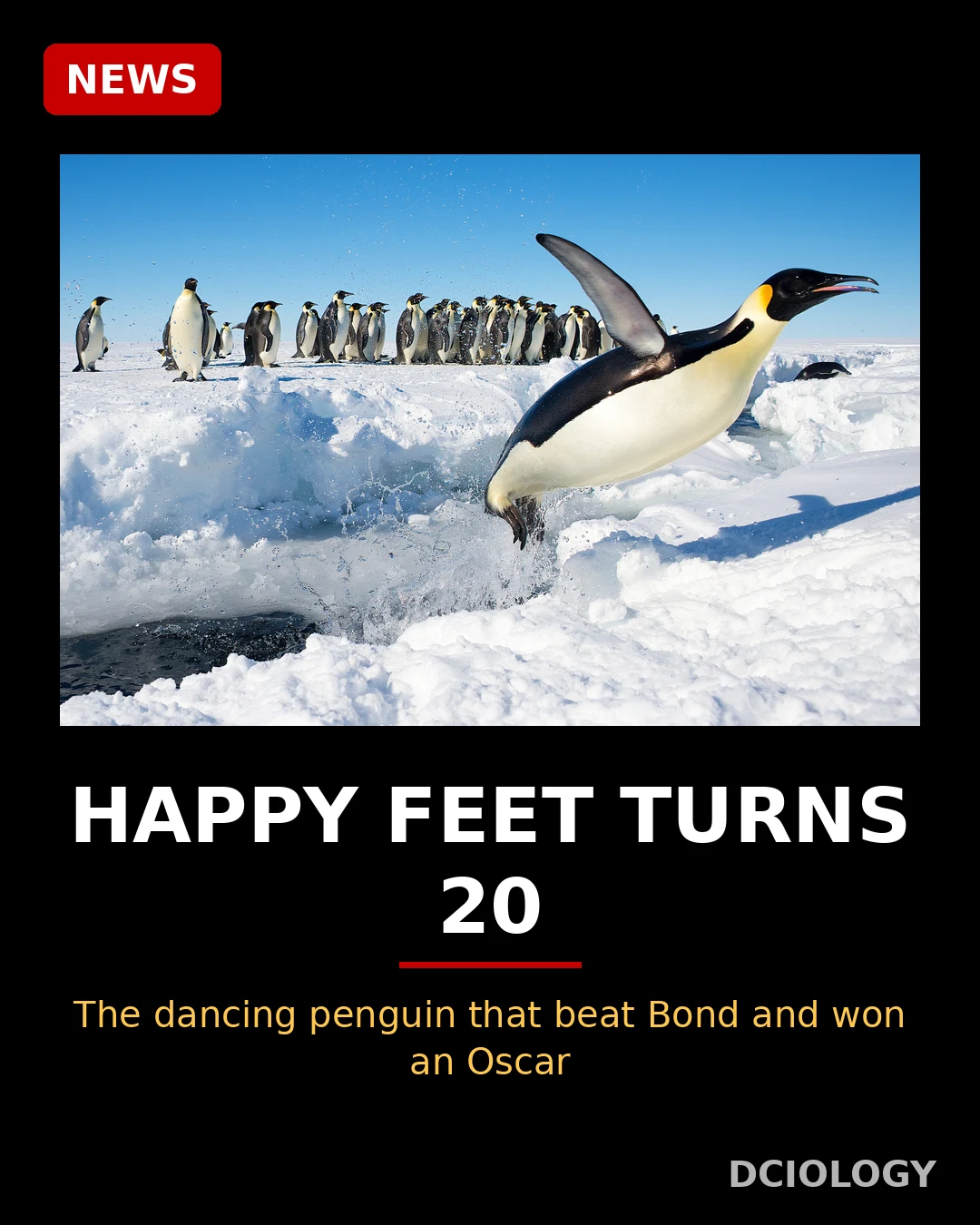
The Happy Feet 20th anniversary arrives today, exactly two decades after the dancing penguin first waddled onto cinema screens on November 17, 2006, and the film still feels like one of the boldest gambles in family animation. Directed, produced and co-written by George Miller, the man behind Mad Max, it turned a story about a penguin who could not sing into a jukebox musical that charmed audiences around the world.
At the centre of the story is Mumble, voiced by Elijah Wood, a young emperor penguin who cannot find his heartsong, the song every penguin uses to find a mate, but who discovers he can tap-dance instead. Around him, Robin Williams, Nicole Kidman, Hugh Jackman and Brittany Murphy bring warmth, humour and heart to a world built on music, movement and belonging.
Happy Feet 20th anniversary: a penguin who danced to his own beat
The Happy Feet 20th anniversary is a reminder of how unusual this film was for a big family release, because it trusted music, dance and emotion more than easy jokes or familiar formulas. Miller built the story around Mumble’s difference rather than treating it as a flaw, and that choice gave the film a gentle message about acceptance that still lands with children and adults alike. For readers who want the full production background, Happy Feet is covered in detail on Wikipedia, from its animation work to its awards history.
Beating Bond at the box office
Few family films open by beating James Bond, but that is exactly what happened when the film arrived in US cinemas on November 17, 2006, taking the number one spot on its first weekend with $41.6 million. It stayed at number one for three weeks, including a $51.6 million five-day Thanksgiving weekend, and finished with $384.3 million worldwide, $198.0 million in the US and $186.3 million overseas, against a $100 million budget.
The Happy Feet 20th anniversary puts that opening in fresh perspective, because few animated films have ever beaten a Bond release so decisively, and it became the tenth-highest-grossing film of 2006.
An Oscar win that made history
The Happy Feet 20th anniversary also marks a proud awards story, because the film won the Academy Award for Best Animated Feature, the first such win for Warner Bros. and only the fourth for a film outside Disney and Pixar. It also won the inaugural BAFTA Award for Best Animated Film, while nominations for the Annie Award, the Saturn Award and the Golden Globe for Best Animated Feature showed how widely its craft was admired, even though the Annie and Saturn honours went to Cars.
Why the music still works
Part of the film’s lasting charm is its soundtrack, a jukebox mix that lets the penguins sing familiar songs in fresh ways while Mumble answers with rhythm instead of melody. That contrast gives the story its energy, because every dance step feels like Mumble speaking in the only language that truly fits him, and the film never asks him to change who he is to belong. Parents who watched it in 2006 are now sharing it with their own children, and the message about celebrating difference feels just as relevant today.
The sequel, and the legacy that followed
The Happy Feet 20th anniversary also invites a look at what came next, because Happy Feet Two arrived on November 18, 2011, with mixed reviews and a far quieter reception than the original. It did not match the first film’s critical or commercial success, and its performance led to Dr. D Studios closing down, a reminder that even a beloved original does not guarantee a second triumph.
Twenty years on, the film endures because its hero wins by being himself, and the Happy Feet 20th anniversary is a good moment to revisit a musical that trusted its audience. Family animation has moved on since 2006, with new releases such as Shrek 5 and Zootopia 2 keeping the genre busy, yet few films have matched this penguin’s joyful, dancing spirit. That is why, two decades later, Mumble’s tap-dancing still brings a smile.