Green Arrow Comic vs Movie: How Oliver Queen Changed From Page to Screen
Oliver Queen has been shooting arrows at DC’s villains since 1941, but the Green Arrow most people know today barely resembles the one from the comics. This green arrow comic vs movie comparison traces how a second-string Batman clone became a street-level crusader in print, then a television icon who built a shared universe without ever getting his own film.
With Green Arrow back in the spotlight in The Flash #39, out today, the gap is worth a closer look: the two versions share a bow, a beard and a conscience, and almost everything else changed.
Green Arrow Comic vs Movie: The Origin Story
In the comics, Oliver Queen debuts in More Fun Comics #73 in November 1941, created by Mort Weisinger and designed by George Papp, in the same issue that introduces Aquaman. He is a wealthy playboy and owner of Queen Industries, shipwrecked on a desert island, who learns archery to survive and returns home to fight crime in Star City with his sidekick Speedy.
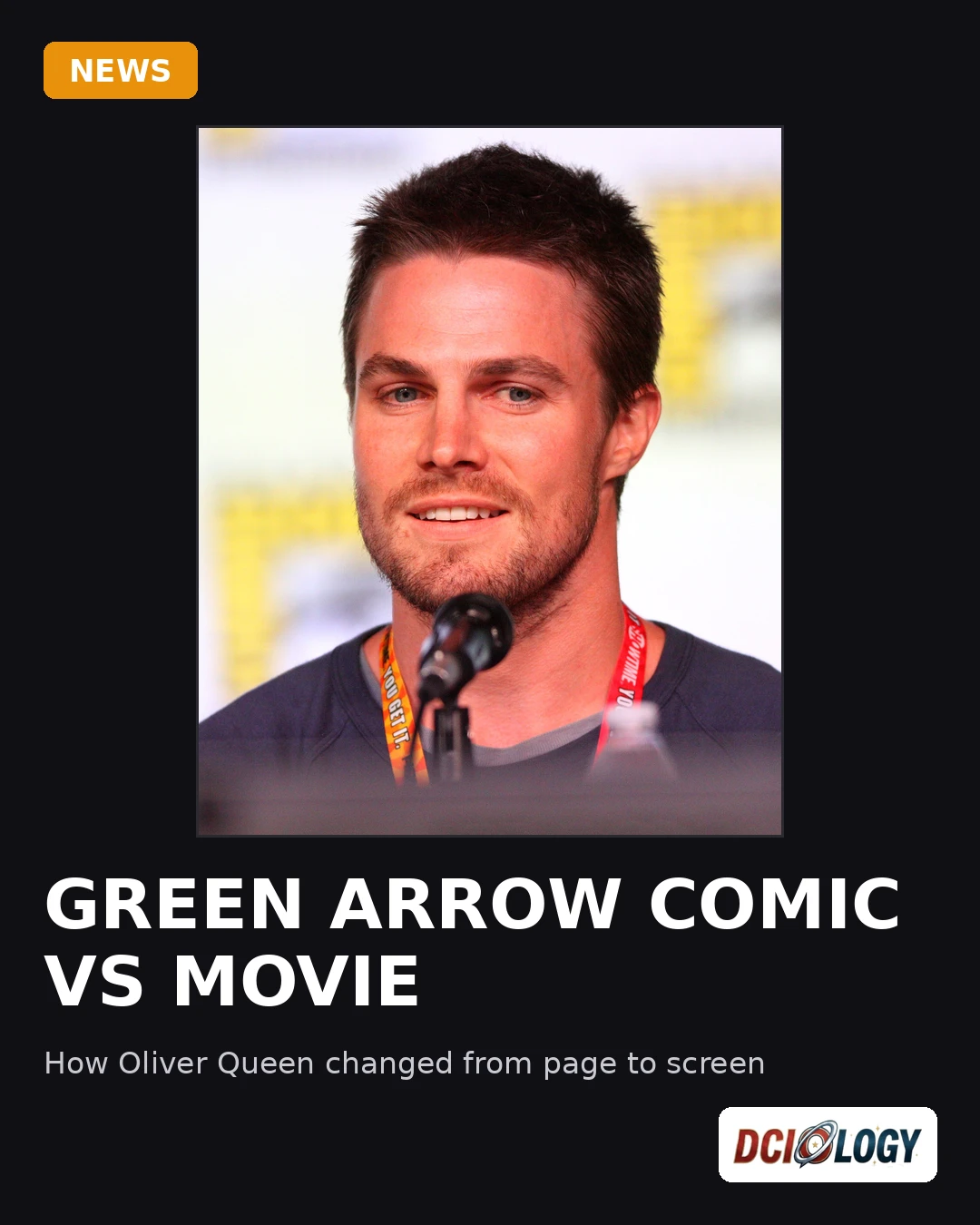
The early Green Arrow is openly modelled on Robin Hood — essentially Batman with a bow. The CW series Arrow, which ran from 2012 to 2020 with Stephen Amell in the lead, keeps the shipwreck but stretches it into five years on the island of Lian Yu, told in flashbacks. The show drops the playboy act fast: this Oliver comes home angry, secretive and willing to kill, a long way from the cheerful millionaire of 1941.
Green Arrow Comic vs Movie: The Politics
The biggest change in the comics comes in the late 1960s, when writer Denny O’Neil and artist Neal Adams strip Oliver of his fortune and turn him into a streetwise crusader for the working class. In the Hard Traveling Heroes stories of 1970, paired with a conservative Green Lantern, Oliver becomes DC’s loudest liberal voice.
The series also reveals Speedy as a heroin addict, one of comics’ most famous moments. Arrow keeps the conscience but softens the politics: Amell’s Oliver fights corrupt billionaires and a rigged system, yet the show is an action drama first, never a lecture. The comics made Oliver a man who lost everything and found a cause; the show made him a man who had everything and had to earn the right to use it.
Green Arrow Comic vs Movie: Death, Rebirth and the Longbow
Mike Grell’s The Longbow Hunters in 1987 ages Oliver up, gives him a beard and a mature relationship with Black Canary, and drops the trick arrows for grounded realism. The 1990s kill Oliver off and replace him with his son Connor Hawke, until Kevin Smith’s Quiver brings the original Oliver back in 2001. The films and TV never attempt any of this. Arrow borrows the beard, the Canary romance and the Longbow Hunters tone, but it never kills Oliver for good: his Crisis on Infinite Earths death is heroic and final, on his own terms.
Green Arrow Comic vs Movie: The Hero Who Never Got a Film
Here is the strangest fact in this green arrow comic vs movie comparison: after 85 years, Green Arrow has never had a solo film. A script called Green Arrow: Escape from Super Max, in which Oliver is framed and sent to a supervillain prison, was written in 2008 and never made. Instead, television built him.
Justin Hartley plays him in Smallville, and Stephen Amell’s Arrow runs for eight seasons and 170 episodes, launching the Arrowverse, from which The Flash, Legends of Tomorrow and Supergirl all spin out. Green Arrow’s long screen history shows a character who conquered TV precisely because no film ever defined him first. Animation keeps him busy too, and now the comics have him back at the centre: in The Flash #39, Green Arrow is the Leaguer whose clash with Wally West turns a disagreement into a full fight.
The comics gave Green Arrow a conscience, a beard and a habit of losing everything; the screen gave him an island, an empire of spin-offs and the most successful superhero TV universe ever built. The Flash comic vs movie comparison showed a hero whose film version is bigger than his comic version; Green Arrow is the reverse, a hero the movies never claimed and TV made its own.
Our Blade comic vs movie and Doctor Doom comic vs movie comparisons cover heroes the films changed completely, while Green Arrow proves the opposite can work too: stay off the big screen, and the small screen will build you a kingdom. The Avengers comic vs movie comparison proved a team can keep its soul on screen; Arrow proved DC could do the same with one man and a bow.