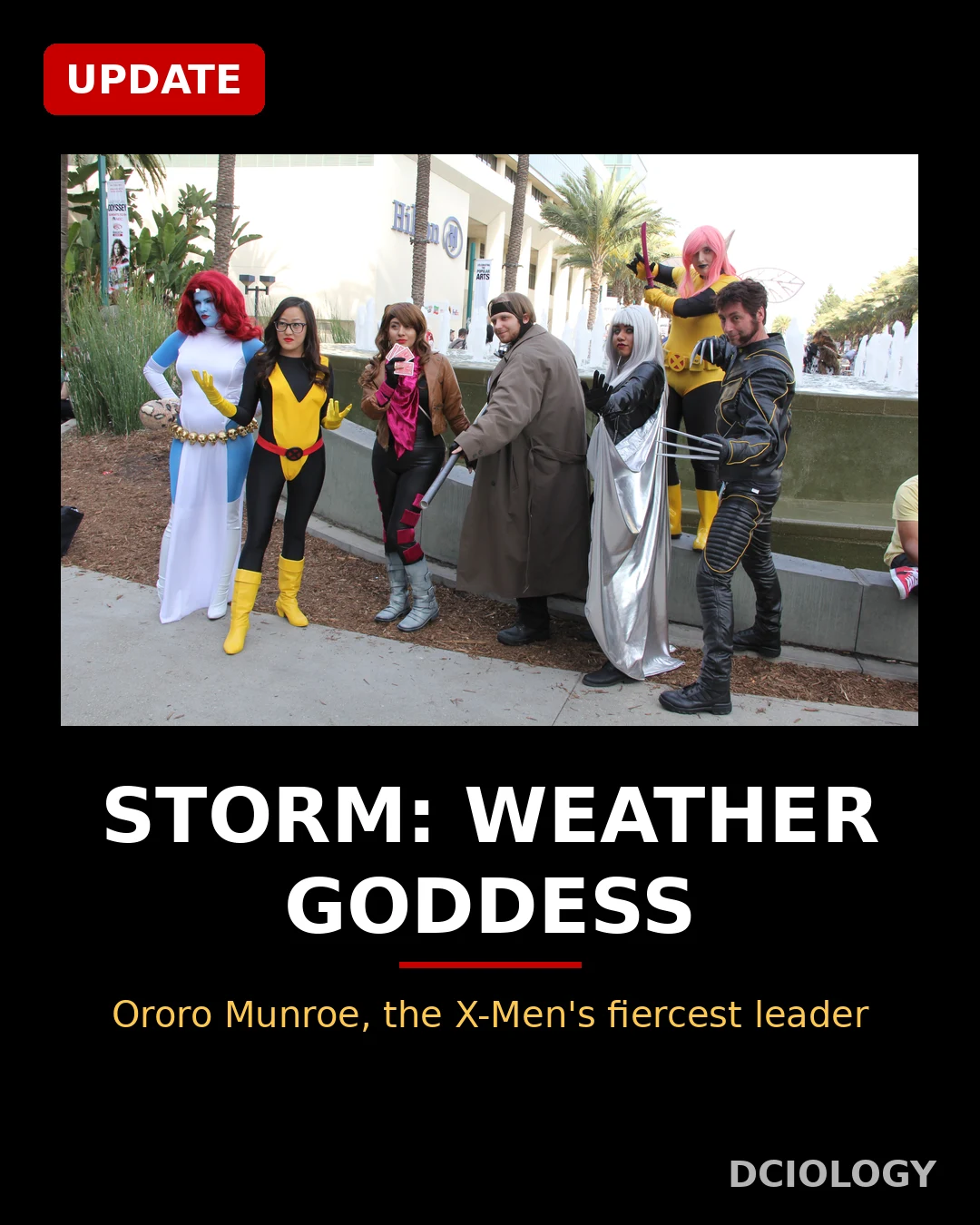
Storm Character Analysis: Ororo Munroe, the X-Men’s Weather Goddess
From Cairo Streets to Weather Goddess
Storm character analysis has to start with Ororo Munroe’s extraordinary origin. Born in Harlem, New York City, to a Kenyan tribal princess and an American photojournalist, Ororo lost her parents as a small child when a plane crashed into their home in Cairo. Buried in the rubble, she survived, but the ordeal left her with a lifelong fear of enclosed spaces. Orphaned and alone, she survived as a street thief in Cairo before her powers led her to Kenya, where villagers worshipped her as a rain goddess.
That journey, from orphan to goddess, is why Storm feels different from other X-Men. She did not grow up in a mansion or a laboratory; she grew up on the streets and in the open sky. When Professor Xavier recruited her in Giant-Size X-Men #1 in May 1975, created by writer Len Wein and artist Dave Cockrum, she joined a brand-new, international team that relaunched the franchise.
The Powers of a Living Storm
In any Storm character analysis, her mutant power comes first: control over the weather itself. She can summon lightning, call down rain, whip up hurricane winds and fly on air currents she creates. She reads the atmosphere the way other people read a room, sensing pressure changes and electrical charges before a storm breaks. At her strongest she has shaped weather across a whole planet, and her power is tied to her emotions, which is why her calm matters as much as her strength.
Her heritage adds another layer to this Storm character analysis. Ororo descends from a long line of African witch-priestesses, women with white hair, blue eyes and a gift for magic. That bloodline explains her white hair and her instinctive feel for forces beyond the weather, and it gives her a mystical side that few X-Men share. She is a mutant, a priestess and a goddess figure all at once.
The Leader Who Beat Cyclops Without Powers
No Storm character analysis is complete without her leadership. Storm became the X-Men’s leader in Uncanny X-Men #139 in November 1980, after Cyclops took a leave of absence following Jean Grey’s death. She held the role through the decade when the X-Men became the best-selling comic in America, and she did it as the team’s first Black leader and its first female leader. Her authority came from judgement and courage, not from being the most powerful person in the room.
The proof came in Uncanny X-Men #201 in 1986, when Cyclops challenged her for leadership in a Danger Room duel. Storm fought him without using any of her powers at all, and still won. It remains one of the defining moments of X-Men history: the weather goddess proving she did not need the weather to lead.
Queen of Wakanda
A Storm character analysis must also cover her marriage to Black Panther. The two had known each other since childhood, and in Black Panther #18 in 2006 they married, making Ororo the queen consort of Wakanda. She left the X-Men for a time to rule beside T’Challa, a rare moment when a superhero’s personal life changed the politics of the Marvel Universe. The marriage was annulled during the Avengers vs. X-Men event in 2012, but the bond between the two characters has endured.
Since then, Storm’s story has only grown. She has led the X-Men again, served as Regent of Arakko on Mars, and in recent years joined the Avengers, headlining her own stories at the centre of the Marvel Universe. Few characters have moved so easily between teams, worlds and roles.
Storm on Screen and What’s Next
On screen, the Storm character analysis continues with Halle Berry, who played Storm in four X-Men films, from X-Men in 2000 to X-Men: Days of Future Past in 2014, making her a household name. Alexandra Shipp took over as a younger Ororo in X-Men: Apocalypse in 2016 and returned for Dark Phoenix. Both versions captured her dignity, even when the scripts gave her too little to do, and fans have long argued she deserves a bigger role.
With Marvel Studios building toward its own X-Men film, Storm’s future has never looked bigger. A Storm character analysis in 2026 ends where it began: with a woman who survived everything the world threw at her and became a goddess anyway. That is why she endures.
For more character deep dives, read our coverage of Iceman Character Analysis and X-Men ’97 Season 2.