Thor Comic vs Movie Legacy
Thor Comic vs Movie: From Myth to Marvel
The Thor comic vs movie journey begins in August 1962, when Journey into Mystery #83 introduced Marvel‘s version of the Norse god of thunder. Created by Stan Lee, Larry Lieber and Jack Kirby, the comic Thor was secretly Dr. Donald Blake, a disabled American doctor vacationing in Norway who found a walking stick in a cave and transformed into the mighty Thor. It was a strange, wonderful idea: an ancient god hiding inside an ordinary man.
More than sixty years later, Thor is one of Marvel’s most recognisable heroes, in comics and on screen. The Thor comic vs movie comparison shows two versions of the same god: one rooted in mythic grandeur and decades of comic continuity, the other reinvented for cinema by Chris Hemsworth’s humour and heart. Both have shaped how audiences see the God of Thunder.
The Comic Book Origins
In the comics, Thor was a founding member of the Avengers, appearing in The Avengers #1 in September 1963. His early adventures mixed Norse mythology with superhero action, as Thor battled his adoptive brother Loki and defended both Asgard and Earth. The book was renamed Thor with issue #126 in 1966, and the character grew into one of Marvel’s cosmic cornerstones.
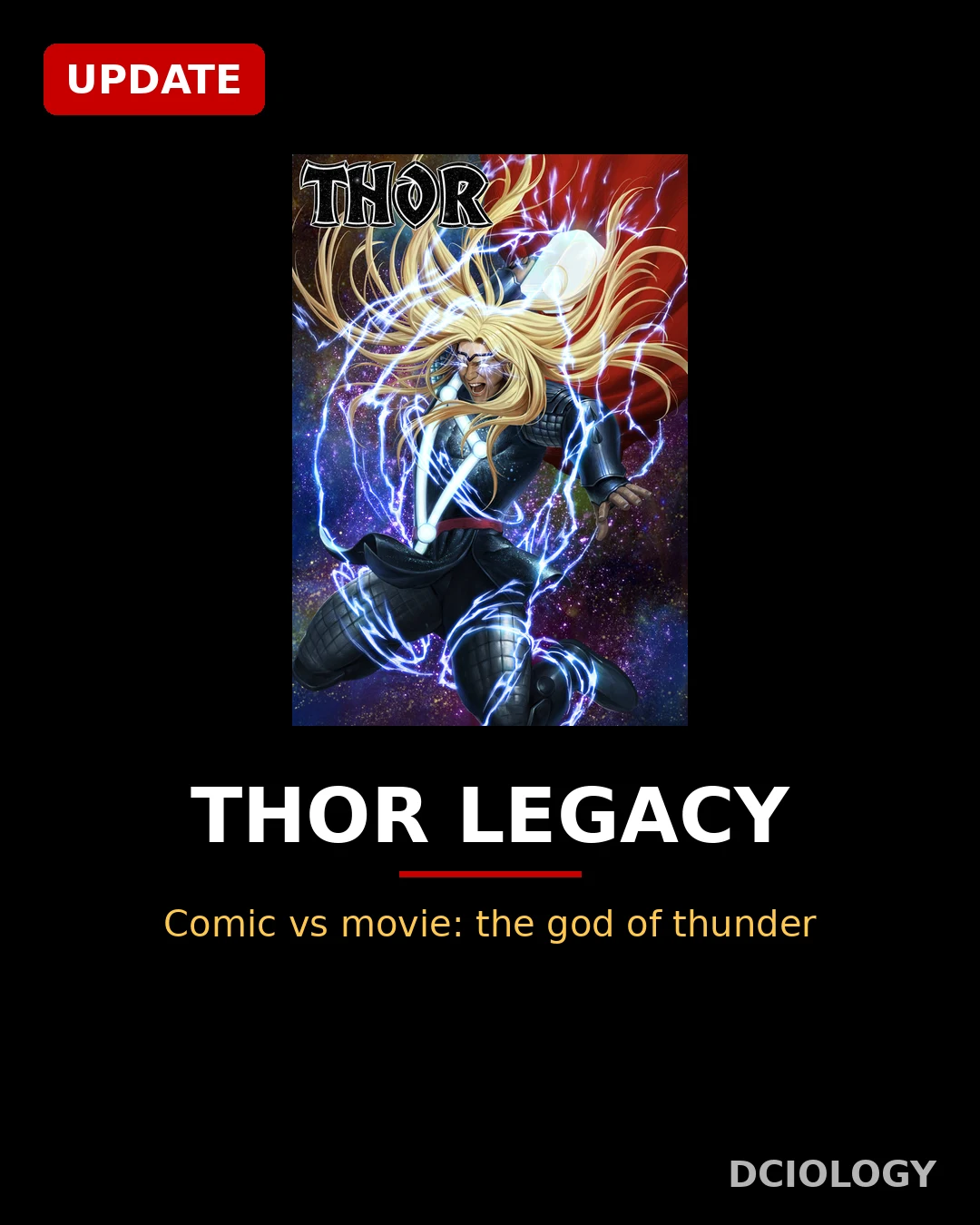
Later comic runs deepened the mythology enormously. Walt Simonson’s legendary run in the 1980s introduced Beta Ray Bill, a noble alien warrior proven worthy to lift Mjolnir, and told the sweeping story of Ragnarok, the twilight of the gods. In the 2010s, Jason Aaron explored what happens when Thor becomes unworthy, and Jane Foster, Thor’s longtime love interest, took up the hammer herself as the Mighty Thor, in one of the most celebrated Thor comics ever written.
The Movie Version: Chris Hemsworth’s Thor
The Marvel Cinematic Universe introduced Thor in 2011, directed by Kenneth Branagh and starring Chris Hemsworth. The film kept the core of the comic origin but streamlined it: Thor was an arrogant prince of Asgard, banished to Earth by Odin until he proved himself worthy. The Donald Blake identity was reduced to a nod, with Jane Foster lending Thor clothes belonging to her ex-boyfriend, a Dr. Donald Blake.
Hemsworth’s Thor evolved more dramatically than almost any other MCU hero. Thor: The Dark World in 2013 kept the Shakespearean tone, but Thor: Ragnarok in 2017, directed by Taika Waititi, reinvented the character as a cosmic comedian, drawing on the comic Ragnarok storyline while adding humour, colour and rock music. Avengers: Infinity War and Endgame then showed a broken, grieving Thor, a human portrait of a god who had lost everything. Thor: Love and Thunder in 2022 adapted Jane Foster’s Mighty Thor storyline, with Natalie Portman wielding Mjolnir.
Where Comics and Movies Differ
The biggest difference in the Thor comic vs movie comparison is tone. The comics often treat Thor’s godhood with solemn grandeur, exploring destiny, worthiness and the burden of immortality. The movies, particularly after Ragnarok, leaned into comedy, making Thor the MCU’s funniest Avenger. That choice divided some comic purists, but it gave Hemsworth’s Thor a longevity few MCU characters have matched.
The films also simplified Asgard. In the comics, Asgard is a vast mythological world with decades of supporting characters, from the Warriors Three to Balder and Sif. The movies kept the essentials, Odin, Loki, Heimdall and Hela. Loki, in particular, became a breakout star, a journey explored in our Loki character analysis comparison. Where the comics gave Thor’s world depth, the movies gave it focus.
The Legacy Continues
Thor’s legacy rests on a single question: what makes someone worthy? In the comics, worthiness is tested again and again, by gods, aliens and mortals alike. In the movies, it is tested by loss, failure and humility. Hemsworth’s Thor began as a prince who believed he deserved a throne and became a hero who understood that worthiness is earned, not inherited.
As the MCU moves forward, Thor remains one of its few original Avengers still standing, and the comics continue to reinvent him. From a thirteen-page origin in Journey into Mystery #83 to a god who has headlined billion-dollar films, the Thor comic vs movie legacy proves mythology never really dies.