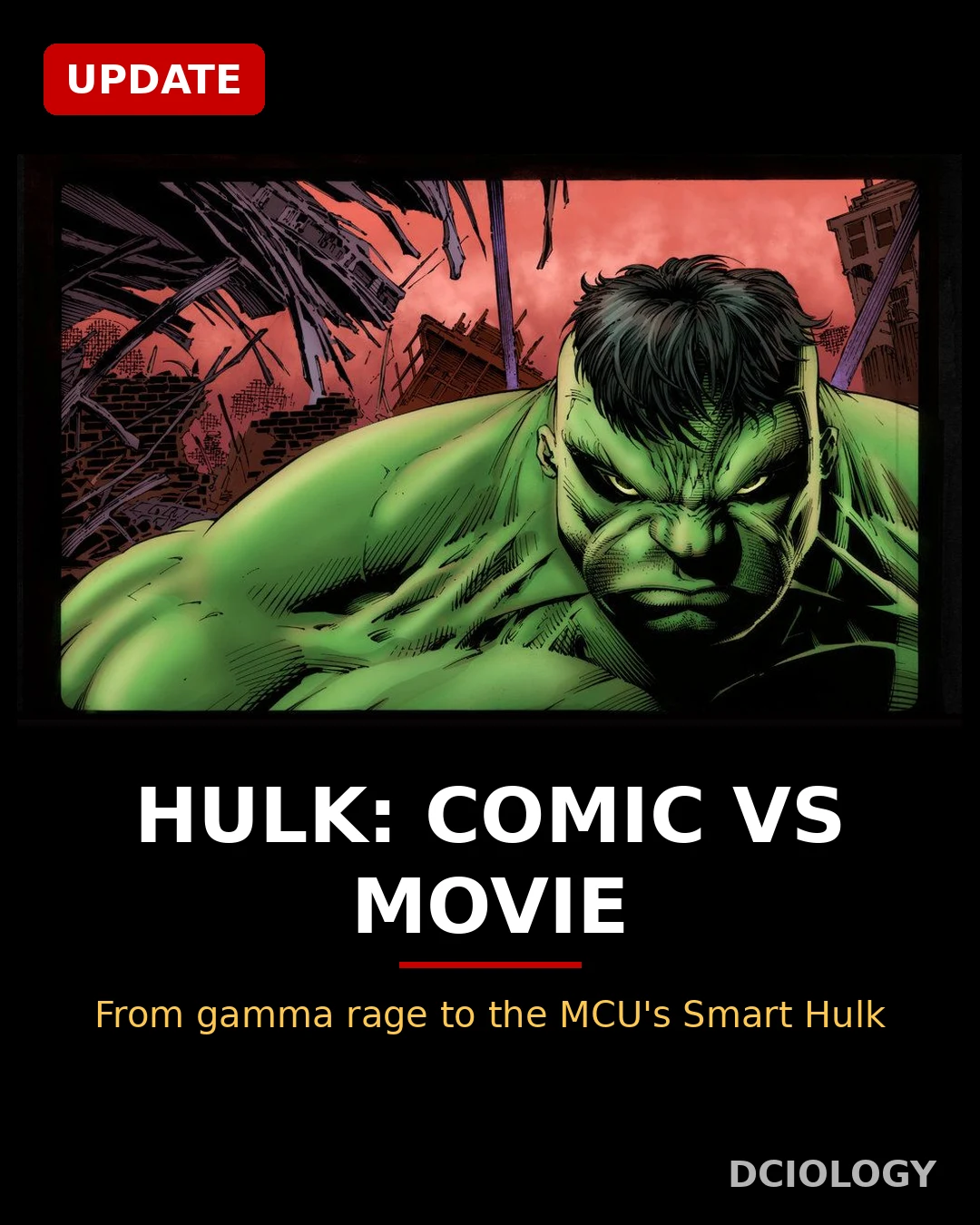
Hulk Comic vs Movie: From Gamma Rage to the MCU’s Smart Hulk
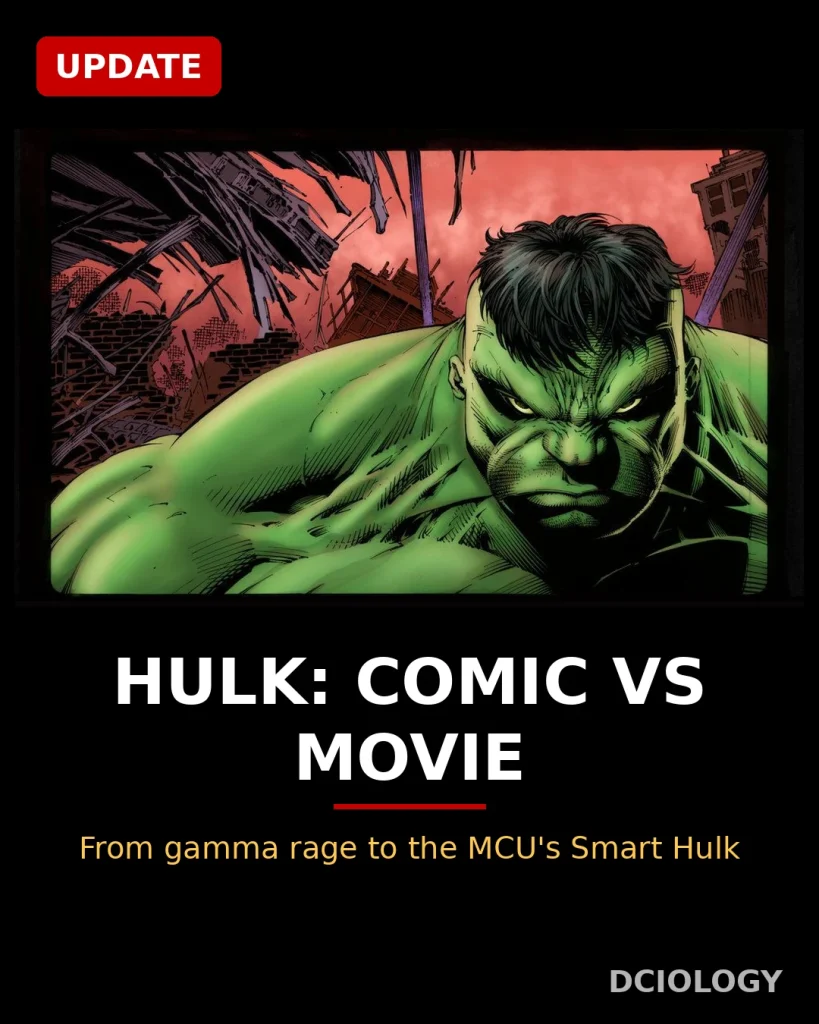
Hulk Comic vs Movie: Born in a Gamma Explosion
Every Hulk comic vs movie comparison starts with a gamma bomb. The Incredible Hulk #1, published in 1962 and created by Stan Lee and Jack Kirby, introduced Dr Bruce Banner, caught in his own weapon’s blast. The radiation changed him: whenever he grew angry, he became the Hulk, a huge and immensely strong creature. The first Hulk was grey, not green, turning green only from the second issue, a printing accident that became an iconic design.
The comics made the Hulk a tragedy from the start: Banner was a gentle, brilliant man trapped inside a monster he could not control, hunted by the army and feared by the public. That tension is the heart of the Hulk comic vs movie story, and every adaptation has solved it in its own way. The comics could let Banner and the Hulk argue for decades; a film has two hours to choose.
Hulk Comic vs Movie: Television and the First Films
The first Hulk most people met was not from the comics. The Incredible Hulk series, which ran from 1978 to 1982, starred Bill Bixby as David Banner and Lou Ferrigno as the Hulk, whose warning, “Don’t make me angry,” became part of popular culture. The show made the Hulk sympathetic, with Ferrigno’s green body paint and torn shirts doing work no effect of the time could manage. For a generation, that was the Hulk.
The movies took longer to get right. Ang Lee’s Hulk, released in 2003 and starring Eric Bana, was a serious psychological drama about a father’s sins and a son’s rage. It was ambitious, but audiences found it slow, and its Hulk felt more like a special effect than a character. The Incredible Hulk in 2008, with Edward Norton as Banner, went the other way, a faster action film built around a Harlem showdown with the Abomination. It was solid but forgettable, and Marvel decided the Hulk worked best as part of a team.
Hulk Comic vs Movie: The MCU’s Smart Hulk
The Marvel Cinematic Universe finally made the Hulk a star by giving him to Mark Ruffalo, who took over in The Avengers in 2012. Ruffalo’s Banner was warm, funny and self-aware, and his Hulk was a fully digital creation who could finally act, driven by Ruffalo’s motion-capture performance. The Hulk stole scenes in Avengers: Age of Ultron in 2015, then took centre stage in Thor: Ragnarok in 2017, which borrowed from the Planet Hulk comics and stranded him on Sakaar as a gladiator champion.
Then came the biggest change in the Hulk comic vs movie story. In Avengers: Endgame in 2019, Banner and the Hulk merged into Smart Hulk, Banner’s mind in the Hulk’s body. The comics had tried similar ideas, most famously Professor Hulk in the 1990s, but the films made it permanent, and the version seen since, including in She-Hulk in 2022, is a calm, controlled Hulk who wears cardigans and runs a lab. It is a long way from the raging monster of 1962, and it divides fans as the comic version once did.
Hulk Comic vs Movie: Which Version Wins
The comics have kept pushing the character darker. World War Hulk in 2007 sent a betrayed Hulk back to Earth for revenge, and The Immortal Hulk, begun in 2018, turned him into a horror story about death and resurrection. Those stories are too strange and too violent for a family blockbuster, and that is the real lesson of the Hulk comic vs movie debate. The comics can afford to be weird, angry and experimental, because a comic can take risks a blockbuster cannot.
The films, in return, gave the Hulk something the comics never could: a face the whole world recognises. Ruffalo’s Hulk is warm where the comic Hulk is frightening, funny where the comic Hulk is tragic. Both versions are true to the original idea: the strongest creature on Earth is also the loneliest. The Hulk comic vs movie story is not really a contest. It is the same character in two languages, and the gamma explosion that created him in 1962 is still echoing through both today.