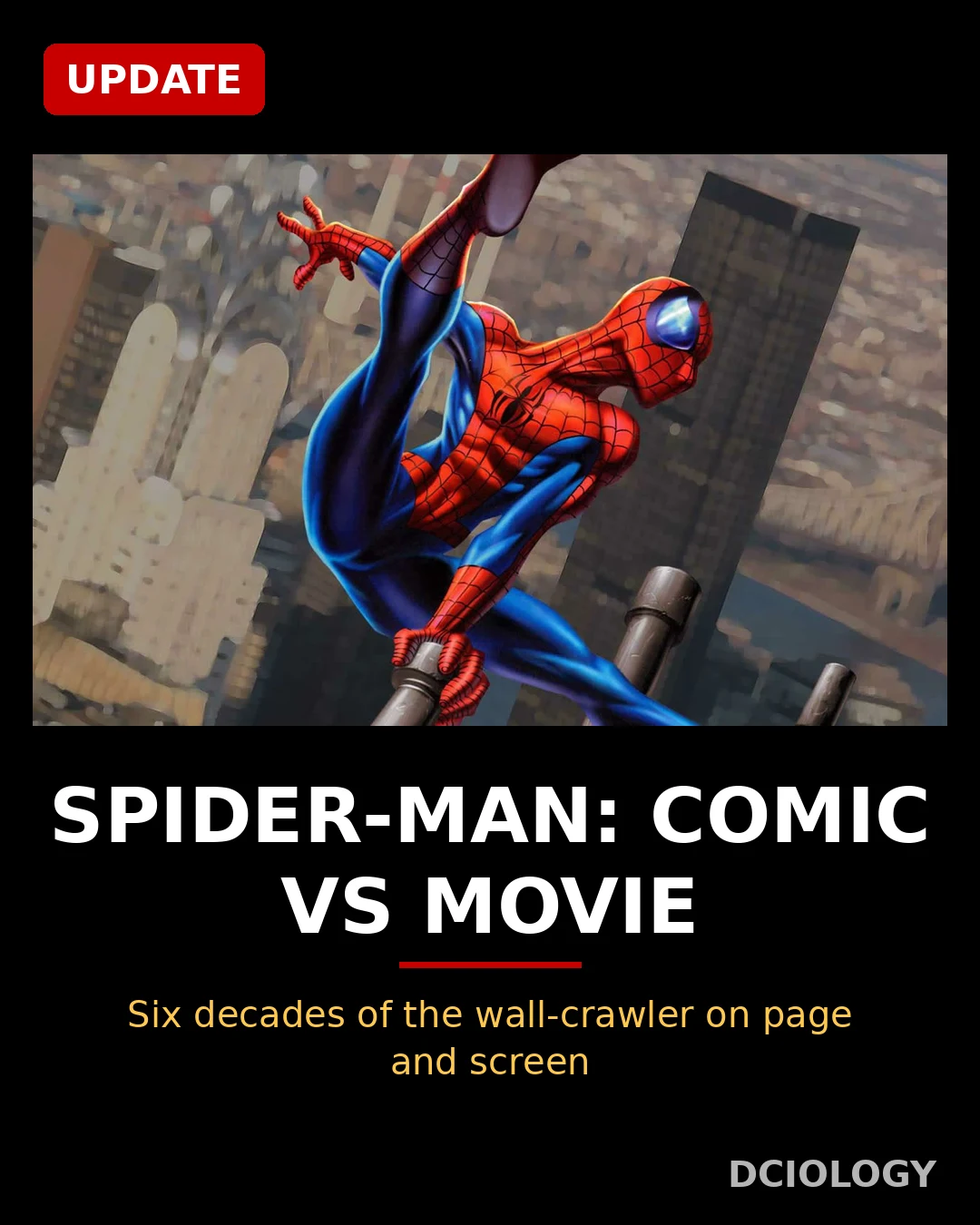
Spider-Man Comic vs Movie: Six Decades of the Wall-Crawler
Spider-Man Comic vs Movie: Where It All Began
Every Spider-Man comic vs movie debate starts in the same place: Amazing Fantasy #15, published in 1962. Stan Lee and Steve Ditko created Peter Parker, a teenager from Queens bitten by a radioactive spider, who learned the hardest lesson in comics when his Uncle Ben was killed by a criminal he could have stopped. With great power comes great responsibility, and that line has shaped every version of the character since. The comic made Spider-Man different, because Peter Parker was a kid with homework, money worries and girl trouble, not a billionaire or a god.
The comics kept that ordinary life at the centre for decades, as Peter grew up, graduated, got married and lost loved ones. Landmark stories like the death of Gwen Stacy in 1973, Kraven’s Last Hunt in 1987 and the arrival of Miles Morales in 2011 each changed the character. The movies must compress that long life into two hours, and the choices each film makes define the Spider-Man comic vs movie conversation.
Spider-Man Comic vs Movie: The Raimi Trilogy
The first great test of Spider-Man comic vs movie came in 2002, when Sam Raimi’s Spider-Man, starring Tobey Maguire, earned more than $800 million worldwide. Raimi kept the heart of the comics: the shy Peter, the kindly Aunt May, the Daily Bugle and Willem Dafoe’s manic Green Goblin. But he made big changes. His Spider-Man produced webs organically instead of building web-shooters, a choice that annoyed purists but made the film cleaner. Mary Jane Watson, rather than Gwen Stacy, became Peter’s great love.
Spider-Man 2, released in 2004, is still regarded as one of the best superhero films ever made, and the closest any Spider-Man film has come to the comics’ emotional depth. Peter loses his powers because he no longer wants the responsibility, and the famous train sequence shows New York itself loves Spider-Man. Spider-Man 3 in 2007 went too far the other way, cramming in three villains and the black symbiote suit, and showed the limits of fitting too much comic history into one film.
Spider-Man Comic vs Movie: The MCU Years
The Marvel Cinematic Universe took a different approach. When Tom Holland debuted in Captain America: Civil War in 2016, he was already Spider-Man, and his origin was skipped entirely. Homecoming in 2017 made him a teenager mentored by Tony Stark, a relationship that barely exists in the comics. Far From Home in 2019 dealt with the aftermath of Stark’s death, and No Way Home in 2021 reunited Holland with Maguire and Andrew Garfield, whose two Amazing Spider-Man films had rebooted the character with a darker edge.
No Way Home ended with Doctor Strange erasing Peter Parker from everyone’s memory, and that is where Brand New Day picks up. Released on 31 July 2026 and directed by Destin Daniel Cretton, it finds Peter living alone as a full-time Spider-Man, forgotten by everyone he loves, four years later. Zendaya, Jacob Batalon, Jon Bernthal as the Punisher, Mark Ruffalo as the Hulk and Sadie Sink as Jean Grey co-star, as the film returns to the street-level, lonely Spider-Man of the early comics. It is the MCU’s most comic-faithful Spider-Man story because it takes away everything the movies had given him.
Spider-Man Comic vs Movie: The Animated Revolution
The most faithful Spider-Man comic vs movie adaptation may not be live action. Spider-Man: Into the Spider-Verse, released in 2018, won the Academy Award for Best Animated Feature by treating the comic book page as art, with halftone dots and panel layouts built into the animation. Its 2023 sequel, Across the Spider-Verse, gave every universe its own visual style. Together they proved a Spider-Man film could look like a comic and feel like cinema.
So which version wins the Spider-Man comic vs movie debate? The comics remain the deepest version, with sixty years no film can match. The Raimi films captured the heart, the MCU captured the scale, and the Spider-Verse films captured the look. Spider-Man works on page and screen for the same reason he worked in 1962: he is an ordinary person trying to do the right thing, and that story never gets old.