
Batman: The Dark Knight With No Superpowers
A batman character analysis has to start with a paradox: the most famous hero in DC has no superpowers at all. Bruce Wayne cannot fly, lift a car over his head, or heal from a bullet wound. He is a man in a costume, armed with training, gadgets and an unbreakable will — and yet for more than eighty-five years he has stood beside gods and aliens as their equal. That is the secret of Batman: he proves that being human is enough.
A Batman Character Analysis Begins With Crime Alley
Batman first appeared in Detective Comics #27 in 1939, created by Bob Kane and Bill Finger. Bruce Wayne was a boy when his parents were murdered in Crime Alley, and that night shaped everything that followed. He gained no powers from the tragedy; he made a vow instead. He travelled the world, mastered detective work, martial arts and science, returned to Gotham to wage war on crime as Batman.
Gotham itself is part of the character. It is a city of shadows and fear, and Batman turns fear against the criminals who created it. His costume is a weapon: the bat is a creature of the night, and he wants criminals to believe he is something more than a man. Beneath the symbol, the detective is at work, reading clues and outthinking opponents stronger than he is.
The No-Kill Rule and the Detective Mind
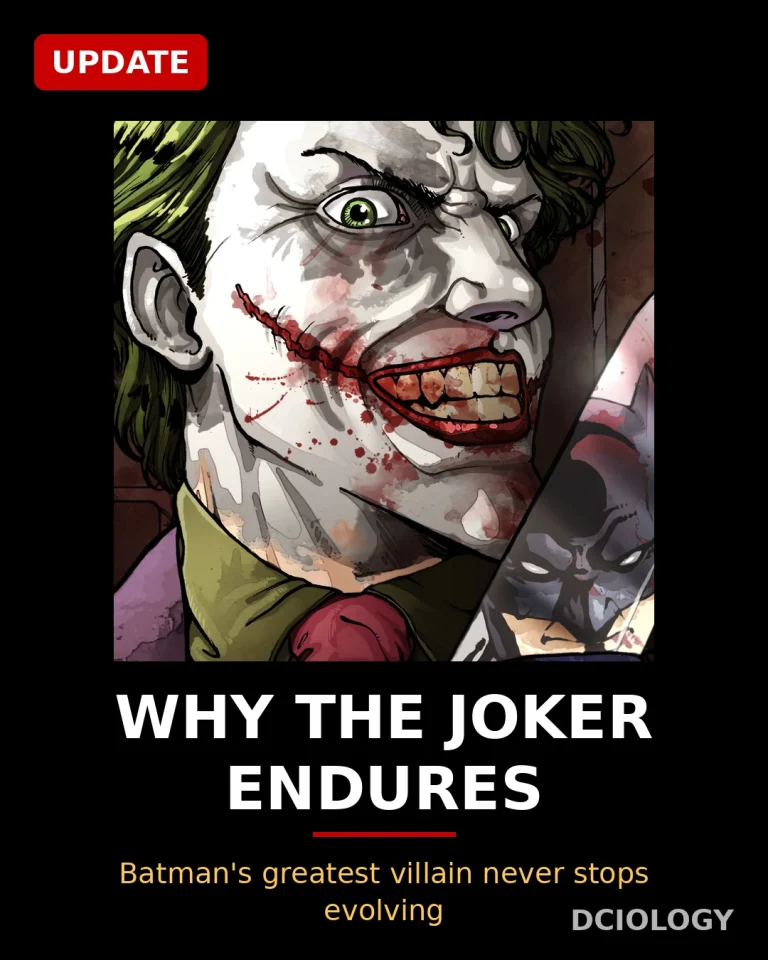
This batman character analysis keeps coming back to two rules that define him. The first is the no-kill rule: Batman will not take a life. The line separates him from the criminals he fights and from heroes who kill without hesitation. Every time he spares the Joker, he proves the rule costs him something — and that is exactly why it matters.
The second is his mind. Called the world’s greatest detective, he solves crimes the police cannot, sees patterns others miss, and plans for every outcome. His gadgets are tools, not crutches — take them away and he is still dangerous, because the plan is the real superpower.
Bruce Wayne, Batman and the Double Life
The deepest question in any batman character analysis is what the double life costs him. Bruce Wayne plays the careless billionaire, a playboy who cannot possibly be sneaking across rooftops at night. In private he is the mission: training, planning and brooding in the Batcave beneath Wayne Manor. Which identity is real? Both are — and neither is complete without the other.
The Bat-Family and the Gotham He Protects
Batman does not fight alone. Alfred Pennyworth, the butler who raised him, keeps him human with wit and truths. Over the decades he has taken in partners — Robin, Batgirl, Nightwing — and built a family from outcasts who chose the same mission. His villains test him too: the Joker is chaos without reason, Two-Face is justice broken in half, and the Riddler challenges his mind. For how the comics built this world, see our Batman comics new era.
Robert Pattinson and the Future of the Dark Knight
No batman character analysis is complete without looking at where the character goes next. Robert Pattinson’s Batman returns in The Batman Part II, directed by Matt Reeves, which has been filming since June 2026 and is scheduled for release on October 1, 2027. Pattinson remains Batman even after being announced as the new James Bond on November 16, 2026 — a double act in Hollywood.
The sequel’s cast includes Scarlett Johansson, Sebastian Stan as Harvey Dent, Colin Farrell, Jeffrey Wright, Andy Serkis and Barry Keoghan’s Joker. Compare the films with the comics in our Batman comic vs movie legacy.
Why Batman Still Matters
In the end, this batman character analysis comes back to a simple idea: Batman endures because he is the hero anyone could be, with his discipline, his resources and his refusal to quit. He has no powers to lose and no alien home to return to — only a promise made in an alley, kept for more than eighty-five years. That is why the Dark Knight defines DC, and why Gotham will need him. His story began in Detective Comics, as our Detective Comics milestone explores.